
One Star

One Star

Wednesday, January 26, 2022

Real Magic Fake Experts


          There is a popular meme, "some of you have never [experienced X] and it shows." I think, looking at a lot of forums, that can be said about real magic.

          A lot of popular books on magic focus on religious and mystical experiences, self-help, and seeking psychological catharsis. It's less common for magic to be focused on miraculous effects, or even not so miraculous but still discernibly magical effects. As a result, for a lot of people magic stays within the realm of religious experience and mental reflection - or rituals to give you the feels.

          Sometimes that's ok. Sometimes that's what people need. I wish we could get away from calling some of those activities magic, because it muddies the waters of discussion and makes it harder for people trying to find actual magic to find it.

          Browsing forums over the years has made me realize there are three things which people often say which indicate that either they have a shallow knowledge base or they have little experience of the actual capability of magic to make real world changes. Not everyone needs a deep knowledge base, and not everyone needs to make or recognize miraculous moments. It's unfortunate when the ideas that stem from this paucity become common or predominate though, and sadly they often are.

          The first of these is the knee jerk response that everything is dangerous. Yes, everything is dangerous. You are at risk if you lay in bed all day, you are at risk if you get up and leave your bed. That doesn't mean nothing should be done. Risk has different levels. Different ways to mitigate and control risk exposure exist in different activities. Different situations and potential successes make the acceptable level of risk also a variable factor. So an empty response of "that's dangerous" does no one any good.

          People who understand what they're talking about might explain what the dangers are, and how to successfully manage them. Or they might say "this approach is undesirable because these dangers exist and it doesn't manage them or have enough success to make them worthwhile, this other approach is better because XYZ reasons."

          People who don't understand things are more likely to say "This was written by this author I've never read, his materials are advanced but he was a bit mad and so his work is too dangerous to be useful." "This author was in league with dark forces and they led him to misunderstand the true nature of magic, which I understand from studying systems that are watered down versions of said author's work."

          Ok, so they won't hand their ignorance to you on a silver platter like that, but it's easy enough to read between the lines. More often you'll just get "that kind of spell is dangerous," "no one should ever do that because you can't control it," "only dark magicians would do that kind of magic, it's very dangerous," or other similarly vague and spooky warnings with no substance.

          The real keys here are "is the warning substantive?" and "does the substance make sense?" If the answer to these questions is no then maybe look for someone else to answer your questions. If your answers are always like that, maybe realize you aren't ready to answer questions.

          The second common fail-boat response is, "google it," "we don't spoon-feed people here," "no one is here to teach you," "shouldn't you know that if you're ready to do this magic?"

          Admittedly, sometimes, the last challenge to a question is a reasonable one. Google it might be a reasonable response occasionally too based on the way someone is asking stuff or if you've provided some help but they need more. The other two make sense much less often.

          I've written about this before. In most disciplines, experts are overjoyed to talk about their specialized area of expertise. Experts often want to share and teach. In magic, this is actually often the case too...although a lot of experts don't like the drama and hassle of public forums so they just aren't super active there. They might skip responding to posts if they don't have time or interest in answering. I have rarely see any bruskly brush off a sincere question. In the case of a forum, I would also assume any question that isn't clearly trolling is sincere enough.

          Magic doesn't have a clear bar for expertise. Expertise isn't easily testable. Expertise could refer to practical capability or to learned knowledge and those would have different measures. There are no standards or accreditation organizations. There is nothing barring Andy Random from reading a book or two, attending an online chatroom sabbat ritual and declaring himself a high priest of the ancient moon cult of witches. People do this pretty much daily. A lot of people establish their status as experts in forums by virtue of being loud and condescending. There are also those who establish it with fancy names, flashy weird back-stories, and routine seemingly pithy hot-takes that are easy to deconstruct but too sassy to want to shoot down...but that's a whole different issue.

          The loud and condescending sort would never dream of answering questions. Because they'd have to reveal that they don't know stuff. Actual experts will answer things when they have the time or inclination, and they will admit they don't know or are not the best source of information when something is outside of their scope.

          The final example is the one which made me write today's post. Originally I was just going to tweet "people who think magic never has any actual methodology clearly have never experienced real magic," or something like that. Maybe pithier...maybe more scathing, or maybe more gentle. Then I thought, "well it needs more clarity, so maybe a longer tweet? maybe a Facebook status?" Then I decided I'd do a blog post...just a paragraph or two, but then this happened. That's pretty much me in an exploded nutshell though.

          Anyone familiar with forums knows that the most predominant idea in the magical and NeoPagan communities is "it's all about intention," "the only thing that matters is intention," "there are no rules, it's just whatever it means to you because it's about intention," "answers to your question don't matter, because what matters is how you feel because it's about your intentions."

          Intention is important in magic, because magic is often accomplished through taking various mundane actions and combining them in a symbolic way and activating them through the intention to perform magic by doing them. Intention is important in the sense that magic is an intentional act. Even that is kind of a weak argument for intention because there is more to it than that. Not any actions performed with the intention of doing magic will always produce magic, and some actions might produce magic even without an aware intention on the part of the doer.

          The idea that magic is about what you intend to manifest, and that magical acts are relatively meaningless in the face of your intentions is a nonsensical sort of misunderstanding and one which is very easily demonstrably false. If this were the case, we wouldn't ever need to learn any magic, we could just intend for things to happen. We wouldn't ever run into mistakes or mishaps in magic, because our real intentions will just show through no matter what we do. Everyday acts would all be magical because we would always have some intended outcome, and things would always match our intentions. Instead of the saying "the road to hell is paved with good intentions," being common in our culture, we would instead recognize universally that what someone intended to do is what's important, because their intentions will win out in the end.

          Obviously, I am not a strictly by the book magician. I'm an educated magician, but I have all the messy eccentricity that just about everyone who grew up with bits and bobs of magic and the influence of spirits they encountered as children shaping their early experiments in magic. I think experimentation, innovation, and substitution are necessary. I also think these things are better when people have a good base knowledge of the system they're working with and other systems. I also know that there are things which can go wrong when symbols, materials, names, and spirits are used without understanding them or without working with them in the correct ways.

          Ironically, people who are quick to mock assertions that some things are correct and other things are incorrect are the same people who will say "never try this because it's spooky dangerous." This overlap kind of illustrates how both are based in not really getting that magic has real power, and that power can do great things, and that great things can be stuff we're happy about or stuff that devastates us.

          I have seen real magic do intense things. Sometimes, intense things can be really small but still incredibly impressive. Sometimes they are huge. I've seen it destroy towns, end lives, save lives, save homes, deliver fortunes to people unexpectedly, I've seen liquidations of investments in failed businesses yield people great returns, I've seen people healed of things where doctors were confused or avoid illness that seemed unavoidable. The list of stuff where it is inexplicable and clearly not just psychology or coincidence is endless. Magic being real and powerful doesn't mean people are throwing fireballs or flying around cities, or using magic carpets instead of airplanes. It means real powerful effects which can shake the foundation of your perceptions of reality and power are a standard element of magic.

          When we consider that simple tools can have that kind of power we must consider that there are correct and incorrect ways to use those tools. This isn't meant in a moral sense. I'm not saying if you want to destroy some village because someone offended you at a dinner party that that is an incorrect use of magic. It would be a pretty awful thing to do and I'd hope you weren't going to do it. I'm saying I've seen things that let me know that that is possible. I've seen things that let me know that completely innocent uses of magic can go horribly wrong when we don't understand how the tools we're using work or how they assemble into the effects we're trying to create.

          So when someone says "these things shouldn't be used together because of the way their effects combine or cancel," or "this should be used in this way but not this way because chances are this will happen," we should ask why and explore whether or not the advise is reasonable. We shouldn't mock the idea that the advise exists because it's all about intention.

          If your answer is "I lazily spin in my chair while wearing three talismans and sitting next to a bowl of crystals and I'm fine," then yeah, you probably are fine. You're probably also not doing any actual magic and aren't equipped to answer questions about actual magic. Your practice of feeling empowered is probably great for you, but that's probably most of what you've got going on.

          It would be very easy to read what I'm saying here as reactive and sensationalist. A lot of real magical work won't do things which are cataclysmic if we make a little mistake here or there. More likely, we'll make a mistake and get no meaningful result, or we'll make a little mistake and our result will be misdirected off from our goal. The damage here is simply the loss of opportunity to get what we wanted or needed. This kind of problem can be a great learning experience for tweaking method. If we don't recognize that methods have an impact then we don't consider making those tweaks. Not understanding that there is a reality to magical acts limits us from improving.

          As we become more proficient and move on to more intermediate and advanced methods - if we can really consider them in that kind of hierarchy - we start to encounter possibilities which might have more consistently powerful effects. Depending upon the moment and the magician super simple super basic things can have very powerful effects. There are also approaches that tend to be more likely to produce those because of the spirits or the natural powers which are involved in effecting them.

          As we engage those techniques, we might not realize powers or tendencies that a particular spirit has. Or we might not recognize how certain elements of our timing impact the spirits or the natural forces we are applying to the situation. If we understand those things we can sometimes navigate them. We can put restrictions in place, or take additional measures, or involve other spirits to help manage the effects and avoid undesirable side effects or undesirable means by which the goal is manifested.

          This is not to say that if you do a spell for money that your most likely option for a windfall is a relative dying and leaving you money, so your spell will unintentionally kill someone. There are various reasons why that is not super likely. More to the point, it's saying that if you ask a spirit who gives dignities in war and grants treasure to bring you money, and you do it in the day and hour of Mars, while Mars is exalted, and the Moon is aspecting Mars, and Jupiter and Mercury are in signs ruled by Mars, and Jupiter is afflicted by an aspect with Saturn then maybe violence, war or chaos will bring about your monetary goal. If you recognize those factors, maybe you pick a different spirit, or maybe you choose a different time, or incorporate talismans or ritual magic components to offset the electional qualities of the time at which you're doing your work.

          For a more simple example, a love spell intended to make a particular person desire you won't necessarily end up like the rapey obsession that occurred when Robin Tuney enchanted Skeet Ulrich. First he becomes a doting and vacant servant, following around the witch who ensorcelled him. Then he becomes obsessed, he can't eat, he can't sleep, he tries to see her at inappropriate times, and eventually attempts to rape her. This is the horror story that people hold up as an example of the danger of love spells. It's kind of ironic since it's from a horror movie, albeit minor horror, and usually people would dismiss the idea that magic works the way it does in horror movies.

          Doing a spell which is effective but misguided could easily result in this kind of effect. I am aware of someone doing a spell intended to kind of turn things up in a developing relationship and it involved some pepper oil for passion and the candle caught the oil and ended up igniting most of the spell components in a conflagration. The spell was left in a fireproof area in case something like that happened and ended up safely burning itself out. Something came up and the magician decided to put off their date with the object of the spell and the person effected by the spell became somewhat enraged and demanded they must have their date then. That fiery passion clearly took hold. Nothing bad happened though.

          We could take the mistake further. Maybe we take two red candles and some crimson rose petals for passion. We take some oils for lust and obsession and dress the candle with those and with red pepper oil. We add some additional components for heat and to speed up the spell. We carve the names of the two people intended to get together into the candles and bind the together. The candle for the suitor being spelled gets rose thorns stuck into it to create a painful and irritating desire. We obtain the assistance of an intranquil spirit and command it to disturb the target with dreams, a loss of sleep, a loss of appetite, a burning in their blood, until they are with the person that they are intended to pursue. We agitate the spirit with peppers and fire and threats of damnation. Maybe we are afraid that the target will be too inert because of their nature, so we call on spirits ruled by Mars to stir the blood to action and make our suitor take initiative.

          This spell would be pretty awful, but it would be pretty effective.  It would also be full of things that shouldn't go together in this context unless measures are taken to also cool the effects of the spell and soothe everything which is stirred up in the target. If the person who desires the suitor doesn't want sex, or wants to play coy and feel pursued, then this spell is probably asking for violence to happen.

          Some people might say "this is why you don't do love spells," but you could do one which doesn't do this and accomplishes the goal. Maybe you obtain personal effects from the two people. Put them in a pink sachet with pink rose petals, sugar, a load stone dressed in iron filings and oil suited to affection and attention. Anoint two pink or two green candles with the same oils and carve in their names, drizzle them in honey, and sprinkle honeysuckle over them. Maybe add some elements related to beauty on the candle for the person who wants to be desired, and courage for the person who the spell intends to turn into a suitor. Light the candles next to each other so they will melt into the same place. Call on spirits ruled by Venus and ask them to make the beauty of the individual inspire affection and sweet treatment from the suitor.

          The elements of the spell will effect the nature of the results. In both cases, Sally Spellman obtains her desired suitor. In one case, the suitor is more likely to be wound up, horny, and agitated by desire. In the other case the suitor is more likely to be affectionate and caring and attracted to Sally's qualities.

          It's not the ethical nature of the spell that potentially results in disaster, it's the way the spell tries to create the effect and whether or not the effect is directed and channeled in a way which safely allows the effect and deals with the specifics of how the spell is working. When we don't consider what we're doing, why we're doing it, and how it works, we can't consider how it will develop and how we need to address that development.

          You'll also notice that while I'm talking about dangers here, none of them are spooky vague dangers. All the dangers are based in specific elements of how and why this could be dangerous and how it can be dealt with. This again, is the different between that first issue that reveals that someone isn't super aware of magic.

          All in all, it's easy to be the guy that says "No, that's just spooky dangerous for no real reason," "you should just google it because we won't spoon-feed you," and "your intention is all that matters so do whatever you want." It takes less work to answer questions this way. It takes less work to read a few books, buy cool necklaces and crystals and live an aesthetic that makes you feel good. It takes less work to develop a basic practice of magic and basic understanding and never expand it.

          It isn't just laziness though. It can be scary to open up to a world with more possibilities and more risks. It can be scary to open up to a world where you might have real power and therefore might have to be responsible for things you do with that power. It can be incredibly depressing to hold onto power, and do really cool stuff and still be routinely faced with situations where you can't do anything about them, or where you feel too inert or unsure to try doing anything about them and are forced to still feel small and powerless and to try and unpack those feelings relative to moments of power. It's not necessarily a simpler easier world. It can be a rewarding world, but it is a choice that still opens you up to other things you will have to deal with. It's just as reasonable to not want that world as it is to want the rewards that go with that world. It isn't reasonable to reject that world and then still pretend to be an expert and get in the way of other people finding it.

          Thanks for reading, please show support by following and sharing. You can also visit our Support page for ideas if you want to help out with keeping our various projects going. Or follow any of the links below.


If you enjoyed this please like, follow, and share on your favorite social media! We can be followed for updates on Facebook.


If you’re curious about starting conjuration pick up my new book – Luminarium: A Grimoire of CunningConjuration


If you want some help exploring the vast world of spirits check out my first book – Living Spirits: A Guide to Magic in a World of Spirits


Now Available: An Audio Classand collection of texts on the Paracelsian Elementals


More Opportunities for Support and Classes will show up at Ko-Fi

Monday, January 17, 2022

Is Tarot Spiritual? Does Tarot Require Spirits? Am I a witch if I read Tarot?

A thread in a forum today brought up a quote from a TikTok video about Tarot, which could easily kick off a larger discussion around divination and the concept of what it is to be spiritual, "Tarot does not have to be spiritual. You do not have to interact with the spirit world in order to read Tarot." The quote is by a TikTok personality who goes by Nao.


I haven't seen the video or any other of her work, so I can't speak to that. But questions about tarot and who can read tarot and what it falls into, or what the implications of reading it are come up frequently.


Sometimes people wonder if they can read tarot because they don't think of themselves as a witch, or if they should consider themselves a witch because they read tarot. Sometimes people wonder if its ok to be a Christian and read tarot. I think these kinds of questions tie into the questions of whether or not tarot is spirituality, or magic, or works with spirits.


The first thing to address then is the idea of spirituality or being spiritual.


A lot of people think of magic as a type of spirituality. Many people look at religion as distinct from spirituality. The associations people have here are frequently messy.


Spiritual means that it relates to the human soul and isn't a materialist concern. It doesn't have to do with working with spirits. So the distinction in that tarot quote is a little messy.


Religion is by default spiritual. Your spirituality includes your religion, so when people say that spirituality is for certain types of people and religion is for other types of people, it's generally nonsense. Spirituality is a broader category into which religion fits. It is possible to be spiritual but not religious. If you have a focus on spiritual matters, and spiritual experiences and activities but they're not organized and formal then you are spiritual, but not religious. If you're religious and your religion has meaning for you beyond just being a social network then religion is part of how you are a spiritual person.


No ghosties required.


Tarot, in all cases, involves faculties beyond the material world and our material experience. So tarot is always spiritual.


I kind of want to say "tarot isn't necessarily your spirituality, magic isn't necessarily your spirituality," because often people use spirituality to mean religion, and tarot and magic don't have to be things we approach in a religious manner. But, they do have to concern the spiritual elements of reality rather than reality as engaged by a materialist outlook and so they are always spiritual.


So the opening assertion of the quote is wrong.


It's still important to understand that things like tarot and magic don't have to be how we approach engaging the religious elements of life and they can just be tools. We don't have to define our lives around being tarot readers or doing some magic. The rules, ethics, and special seasonal events we observe don't have to relate to engaging in those practices. Because of the way "New age spirituality" and NeoPaganism kind of package together a lot of things, people sometimes think they need to be part of some bigger bundle, but they don't.


Like numerous other things, tarot, using a pendulum, astrology, or magic can fit into any broader context of spiritual activity without defining what the overall complex of spiritual behaviors in your life are. I think sometimes when we try and define our spirituality as magic or divination, or these things as our spiritual practice, it leads us to ignore how these are the practical elements of spiritual practice. These are the ways that spirituality allows us to know stuff and get stuff done. They aren't just about touching the infinite and feeling feels.


So, do Tarot and Divination need spirits?


In a certain sense, yes, they do. Divination means that we are obtaining knowledge from the divine. A lot of historical great minds in science also explored alchemy, astrology, and magic because they felt like there were limits to what physical science alone could teach them. Traditional forms of education culminated in studying philosophy, and then if you were excelling enough, theology, because things like arithmetic, geometry, logic, rhetoric, music, and the rest were the ground work for being able to understand these higher concepts. Exploring the truth of the divine world was how these academic ideas blossomed into a more full understanding of reality.


In any traditional form of divination, we are working to get knowledge from some sort of spirit or god. It might be ancestors, or spirits between our ancestors and God, or angels, or demons, or gods, or any other spirits with whom we can speak. They speak to us through the tools of divination, and hopefully through direct inspiration which is guided and interpreted through those tools.


A lot of people work with tarot or pendulums, or geomancy or throwing bones, or various forms of divination without calling on spirits to help them.


Who are they talking to?


In my understanding of things, you can use divination tools to try and read the "buzz" of the world. Essentially the harmony of energies and spiritual powers in the world and the way in which they are moving. Exploring that collective movement can tell us things about the particular forces at work in our lives, how they got to be in our lives in their current manners, what their current natures and impact on our lives are, and what direction they're trending towards.


You might think of this as part of the anima mundi - the spirit of the world; or as the spirit of the moment. In that sense maybe you're still working with some kind of spirit.


Some folks who look at the spirit model as the only way anything works would argue that these tools still work through spirits if you're actively working with the tool, you might just not realize that's what's happening. I don't like to take that approach unless I know more about what someone is doing. I think there are ways things can work without direct engagement of spirits.


You're still engaging something spiritual when you're using divination tools. You're still communicating with a living pulsing force beyond yourself. Whether you're doing that generally through trying to read the movements of the world's life, or whether you're asking specific spirits to speak to you through the tool.


If you experiment with both, I think you'll get more grounded, clearer, more actionable information when you engage the right kinds of spirits and use your divination tools to speak with them.


If you're keeping it general and just letting the spirit of the world speak through to you, it's still spiritual, even if it maybe doesn't involve shooting the breeze with some disembodied entity.


If you're approaching tarot or other forms of divination in a way which tries to avoid spirituality...say you're laying out cards and expecting them to be fully random and they're just a guide for self reflection...then you aren't doing divination and you aren't actually reading tarot. You're looking at some pretty pictures and meditating. This might be useful, but again, not really divination.


I would also imagine, divination would still be good to do on top of this. Self-reflection is important and useful, but divination gives you information and knowledge beyond what's already in you. Taking that self-reflection and then exploring a broader perspective than your own, and using what you learn from both is going to get you much further.


So the short of it...


...tarot IS spiritual

...tarot, like magic, maybe doesn't always need to involve spirits but is probably better with them

...tarot, like magic, doesn't have to define your spiritual life even if you use them, so you can use them in any religious context

...tarot, like magic, is spirituality for practical purposes


If you liked this here are ways to follow and support!


 If you enjoyed this please like, follow, and share on your favorite social media! We can be followed for updates on Facebook.


If you’re curious about starting conjuration pick up my new book – Luminarium: A Grimoire of Cunning Conjuration


If you want some help exploring the vast world of spirits check out my first book – Living Spirits: A Guide to Magic in a World ofSpirits


Now Available: An Audio Class and collection of texts on the Paracelsian Elementals


More Opportunities for Support and Classes will show up at Ko-Fi
Thursday, December 23, 2021

Give the Gift of Magic

I would say "the holiday season is upon us" but the holidays related to the darker portion of the year have been in full swing for a month or two now. Here in the USA we tend to be a little Christmas-centric and of course, the secular version of Christmas which dominates our culture is primarily about gift giving. So I suppose, gift giving season is upon us.


Stores far and wide are running sales and released their gift guides months ago.


If you're anything like me, between being busy with so many other things and the weird way in which the new normal seems to have eroded the benchmarks of time passing...it doesn't feel like we're as deep into the gift-giving season as we are. I'm mostly just starting my shopping, which is super unusual for me. I imagine a lot of people are in the same boat, so for the sorcerer on your list...here are some gift options.


There are a ton of friends I have who provide services, classes, and write books. I'm keeping my list small and going mostly with people whose stuff I have used, but even with that limitation this list won't be exhaustive. No one has asked to be added to this list or provided anything in order to get on it. They don't even know I'm making it.


I will obviously start off with my own stuff and then provide links to the work of a handful of other awesome magicians.


BJ Swain


My books, Living Spirits: A Guide to Magic in a World ofSpirits and Luminarium: A Grimoire of Cunning Conjuration provide the spiritous sorcerer with resources to explore and engage a world full of spirits to achieve sorcerous success. Living Spirits will provide an introduction to the history of spirit magic and conjuration, a sort of field guide for exploring types of spirit and spirit ecology, and methods for working with them. Luminarium provides a fast paced method for developing a conjuration practice. It provides instruction for conjuring angels and aerial spirits but can be adapted for a wide range of spirits. Both texts provide methods for consecrating and working with Solomonic pentacles.


Rufus Opus


Seven Spheres and A Modern Goetic Grimoire reflect the systems of magic which Rufus Opus taught for years and which were the gateway for many magicians into modern conjuration. I once had a partner ask if they should work through Seven Spheres and I was very comfortable agreeing that they should. If you take your time with Seven Spheres and work with each sphere until its teachings and powers are fully blossoming in your life before moving to the next, you can achieve a pretty meaningful initiatic journey with very simple methods.


Jason Miller

I have had the opportunity to attend five or six in person classes by Jason as well as listen to one of his Arcane Audios. He has a great teaching style and is personable, accessible, and clearly has done the things he's talked about. His books are also easy to read and comprehend, provide great info, and clearly draw on a wealth of practical experience. I've had numerous friends who have dramatically deepened their experience of magic and expanded their practice by taking his courses.

Jake Stratton-Kent


Jake's Encyclopedia Goetica, comprised of Geosophia I, Geosophia II, Testament of Cyprian the Mage I, Testament of Cyprian the Mage II, and True Grimoire have essentially defined the contemporary grimoire movement. Jake's Archaic Goetia presents an image of what Jake feels magic could be if it had developed uninterrupted with a backdrop of historical imagery and sources Jake paints a portrait of a vision of spirit work which has inspired many magicians. His short work, Goetic Liturgy, should be explored by anyone working in modern magic or lodge magic. Pandemonium and A Sworn and Secret Grimoire are his newer works and further his efforts to highlight magic from sometimes overlooked sources. 


Hawk Grubb


If you need astrology services I can't recommend Hawk Grubb enough. I've even considered getting a consult for a friend myself this holiday season. I've had the pleasure to have several discussions about astrology with Hawk as well as having had Hawk review my chart, and then later discuss elements of it while they appeared on my podcast. I have recommended to other friends that they look to Hawk when looking for a partner for astrological work. Hawk is hands down the first source I'd turn to when looking for an astrologer and they are friendly, knowledgeable, practical, rooted in tradition, and able to clearly tie the stars to things you'll experience in your life.


Practical Occult


Do you need magical treasures? Are your sorcerous friends discerning occultists in search of powerful tools? Then check out the items offered by the infamous Alison Chicosky. I say infamous because she has put some lesser magicians to flight as they clumsily challenged her work recently. Some of this challenge has been over interesting expansions in her product line drawing inspiration from the Greek Magical Papyri. The main product for which Alison is known are her fully consecrated Solomonic Pentacles. I myself have had two of these and they have a powerful presence that immediately begins to move and effect things as soon as they arrive.


Wolf and Goat


Unfortunately, this business is no longer in business. I have not had experience with ordering things from the business so I can't speak to anything related to that. But I have taken two awesome classes they offered. As far as I understand their classes are still available to purchase as recordings. There is one I am considering getting while they are still available. I highly recommend you check them out while they are still there.


Hopefully you'll find some nice options for electronic gifts and services that you can purchase, or gifts you can send to people after the Holidays wrap up with these various providers. Or hopefully you find some cool gifts for yourself.

Update: Originally this was supposed to be a post last week but the sudden rush of catching up with impending holiday events kept me from most work on a computer...fortunately almost all of these options have options for Kindle Editions or EPubs, or online classes, and others are gifts that people will happily receive in the new year.


Thanks for reading Glory of the Stars, if you'd like to show support some way as we wrap up the year, here are some options.

Thanks everyone, have a happy holiday!


Tuesday, October 19, 2021

A World Less Magical

I was meeting with a college friend last week for lunch. He and I hadn't seen each other for a few years even though we had been super tight even for a few years after college, seeing each other at least once a week for a few years after graduating. We were talking a lot about research into family trees, and genetic tests. Eventually discussing changing perceptions of race and family make up led to a conversation about changes in worldview between generations and of course that turned towards the pace of modern materialism and the lack of belief.


My friend is an evangelical Christian. He's very committed to it, and his weekly Bible study schedule was actually what ended up throwing off our routine hanging out as we hit our thirties. Even with his fairly conservative evangelicalism, our conversation included him congratulating me on my Black Crozier award (we had not hung out since before I won that) and the success of my occult books. We couldn't be friends without me accepting his Evangelicalism and him accepting my Pagan-Catholic-Sorcerous-Witchcraft-and-Dionysianism. So, talking about how much magic is in the world isn't a shocking or unusual topic, and honestly, is a topic which should be intensely important for Christians too.


I talked about how when we were kids we learned folk tales in school, and knew the various folk heroes of Americana. We learned folk elements of holidays and some basic folk beliefs as if they were normal parts of knowledge. This was a core part of the fun of elementary education. Some of us got more exposure to this from our parents and our home lives, and for those of us that did, the folk knowledge that was part of public culture probably stuck a little more. It was still something that was there on some level for most people.


We have anthropologists and sociologists finally exploring that folklore is not a past thing, but a continually developing thing. Rather than noble savages and peasantry being the source of folk memory, there are now collections of experiences with the spirit world, and folk knowledge as it impacts modern people with modern lives. There are books and studies countering the idea that materialism killed the spiritual awareness and folk beliefs of that European and North American cultures are somehow more fixed in materialism and rationalism than other cultures.


In my own experience, and the anecdotal experience of many magicians, most people believe in magic or the supernatural when faced with the opportunity for it to exist. They may deny it generally, but still choose safety when it could present some risk, or seek its help in small ways when it is opportune. A friend once told me that his atheist girlfriend appreciated me praying for her because she thought it helped her situation. In school, friends who were Catholic and friends who didn't believe in anything would turn to me as the magic kid for things they didn't feel right praying for or asking for otherwise.


At minimum the average person has retained a belief in possibility, even when that generally is at odds with how they would consider themselves.

I think some of this is changing though. As I failed to understand how to use the table top card reader, displaying my backwards hermit magician status, I bemoaned the death of folk knowledge and magical awareness amongst young people.


I work with college students, and also with children and teenagers. So I get to see a lot of what they think and what they're aware of. Unlike most teachers and coaches, I work with the kids year round, and will have some of them with me from the age of 9 or 10 up through 18 or longer. So I get to the point where they can talk about a lot of what interests them and how they see things. They also like to try and get me to kill time by setting up trivia games.


I have found that as elementary curricula focus more on STEM, and on computer skills there is less room for other things. Kids get a lot less folk knowledge and local history and folk culture. Some of it is probably still there but there is so much else for them to cover as the pace of education accelerates that it doesn't sink in so much


Add to that more activities for kids, and parents keeping activities and hobbies for themselves, as well as keeping up with increase homework as schools try to prepare students for the world loads of higher education by overloading them in lower school...parents probably find less time to sit in fields and talk about why the leaves tremble or what magics certain flowers and things floating in the air might hold.


As kids no longer have the wonder of the world woven into their nascent awareness, the world becomes less magical.


You might say that the world is what it is, and kids will have the opportunity to find it later if that's what they want. I think we mostly know, if we're honest with ourselves, that it usually doesn't work that way even if we like the idea of it working that way. It's easier to say "this might be our there" and have someone decide they don't care about it and ignore it than it is to say nothing and someone to spontaneously look for something they had no idea existed.


Even when people know something exists, like various unusual sports and hobbies, the common impulse of those with some passing interest, even some people with a keen interest is to say "well, I don't know how to find that, it's never been anywhere I've seen." In the religious sphere, lots of people decide they don't believe in God, because they don't believe in the God they've been shown, and don't realize that what they do believe in might exist in some other faith because they don't know other options exist.


Some people will be raised in a world of gray cubicles, and find the cracks that let the light shine in, and realize they can break through those cracks. It won't be the norm.


Still, the world is the world. It will always have its magic and wonder even if people don't pay attention. Right?


In some ways, yes, the fundamental reality of what is won't change. Our ability to engage it will.


I don't believe in consensus reality, or that the collective acceptance of a concept reshapes the objective realness of the world. I do believe that our interactions with the spirit world our shaped by our interactions with the world around us and with the spirits in the world around us. I believe this applies to our individual interactions and our interactions as a group.


If we are unkind to the spaces of spirits, or to the spirits themselves, guardians who see us as part of the environment they guard and assist will become monsters who see us as interlopers. We can see this evolution throughout folklore and faery stories.


More than that, many spirits need the physical world to engage with the spirits and spirit world, or to provide things that break down the barriers of awareness and interaction between those places in order to more fully engage us and engage this world. This is a common element of many magical and religious traditions.


Some elements of engagement include offerings, some include ritual acts, and some are simply engaging awareness and interaction as if they spirit is present with us.


Living in a world where that engagement is always present and where the awareness of the imminent presence of the spiritual is ubiquitous shapes our capacity and the capacity of the spirits. This isn't so much a matter of belief changing the world, but a question of whether closing our blinds impacts how easily we know what's happening outside of our windows.


I spent 12 years working in an area where most people believed in magic, and wore magical amulets and used words and signs to keep away the evil eye and other negative magical impulses. It was an interesting difference in awareness. I wasn't part of the community and didn't live in the community, so I didn't get to fully engage the difference. There was still something perceptible to it.


I've heard stories from people who have visited or lived in places where magic is a general living part of the culture. The consensus seems to be that in those spaces spirit interaction is more common, more visceral, more perceptible and often more effective. Spaces where the average person believes in magic and spirits, and needs their intervention in their lives, and routinely engages that awareness are spaces where magic takes on a different character.


Many of us have recognized that but I'm not sure we internalize what it means for the world, or what we as magicians should be doing in light of that reality.


I made a new friend last night. He was talking about his difficulties making himself study in light of other things he deals with, and I commiserated. He asked about me studying, and I explained that I had research I was doing for a writing project, and that I was currently researching the Faery Queen and her evolution from the Sibyls of Greece through Arthurian Legend into magical texts and practices and how that connected to various pieces of folklore in different parts of the world. He thought it was super cool. Later in the night, another friend talked about taking an extra trip because he didn't want to drive with too many people in his car since cops patrolled the area where he'd be driving. I told him I would offer him a bay leaf so he could drive without being seen, but that I didn't have any with me. The new friend was super confused, the other friend acknowledged appreciating that I would have offered and kind of skirted around addressing the confusion. So I explained why bay leafs relate to invisibility and hiding things.


It was all pretty matter of fact and no explanation was given. The world just included the possibility of magic as if it was a normal thing.


In situations where it's appropriate I try to be this person. A relatively normal person, who doesn't seem like anything bizarre. A normal person who might answer questions about magic or answer non-magical questions with magical answers, as fluidly as a non-magical answer might be given. Not in a showy or weird way, in places where it's appropriate or would be as normal as anything else.


I hate the internet trend of saying "normalize" things. It frequently involves stuff where the goal isn't to make something normal, but rather to make it comfortable and unstigmatized. Part of me wants to say that we should normalize magic, but that isn't really the goal either. Magic shouldn't ever be normal because magic needs to be visceral and kinetic. Magic should be present and a visible part of the world.


Obviously, care has to be taken as far as context. Some people are people who you probably don't need to be a magician in front of. Others might be people where it's ok. Sometimes keeping magic present in the world doesn't have to involve you being magic. All situations are different.


At the very least, avoiding a world less magical is a thing we should consider.

If you liked this here are ways to follow and support!

 If you enjoyed this please like, follow, and share on your favorite social media! We can be followed for updates on Facebook.


If you’re curious about starting conjuration pick up my new book – Luminarium: A Grimoire of Cunning Conjuration


If you want some help exploring the vast world of spirits check out my first book – Living Spirits: A Guide to Magic in a World of Spirits


Now Available: An Audio Class and collection of texts on the Paracelsian Elementals 

More Opportunities for Support and Classes will show up at Ko-Fi
Wednesday, October 6, 2021

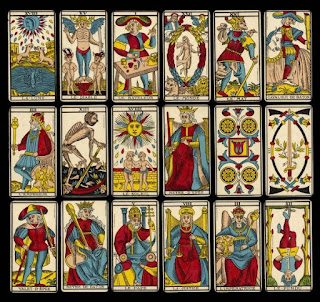
Strange and Norrell Tarot: The Childermas Cards of Marseilles

If you've been my friend on Facebook for awhile, you probably know that I was really impressed by Susanna Clarke's _Jonathan Strange and Mr.Norrell_. I was originally pointed to the book by a member of my local OTO lodge and kind of brushed it off (a mistake on my part), but I watched, and loved the BBC series. I've probably watched it five or six times now - fortunately it's not too long, despite how much content is there.


It does a great job of illustrating what I see as major issues in the "revival" of magic.

When you dig deeper though, there is a ton of really excellent thinking about magic and spirit work woven into the story.


I don't tend to read much fiction so I never got far in the book. But times I've flipped through it or times my friend has sent me quotes, there are so many things which really illustrate magic.

I even quoted it at the beginning and end of my first book, and I kind of view the magic of the Raven King as something likely not too far off from my view of things...at least the bits of it I've seen.


If you haven't read it or watched it I recommend doing whichever of those you would prefer. But this post isn't going to dive into the magic of the book.

BBC really missed the boat, because they made a beautiful rustic version of the Tarot of Marseilles for the series, and there is a good story and a great character its presence attaches to, and cool scenes using it. But, despite all that, they did not release a "Childermas Tarot" or "Strange and Norrell Tarot." It would have been a huge hit I think, even with Tarot traditionalists.

Even the images of the cards visible in the show don't seem to have been collected to make a printable tarot set.

I decided I wanted to make a set for a friend for a gift recently. He loved them. 


To make my set I collected the various images, tweaked a few of them, and set them as 3x5 images with 4 images per 8.5x11 page. I then printed them on cardstock, and then printed a raven pattern on the back of the card stock.

I cut each of the 16 cards out, and took self adhesive laminate and laminated four cards per pocket. Then I cut the laminate out around the edge of the cards and had a wonderful pack of 16 tarot cards as a cool piece of Strange/Norrel show gear.

I will probably make myself a set and one for a friend who hopefully I'll see later this month. For everyone else though...I wanted to share my files so everyone can have a lovely print at home Childermas Tarot.

Obviously the artwork here belongs to the BBC. It is all over the internet and hopefully they don't mind it being shared this way. More importantly, it is my hope that should Susanna Clarke learn that people want Childermas Tarot decks, she will like how awesome people find her characters and how much people recognize the magic present in her work.

My standard links for checking out my books and supporting my blog are present on this post, but I want to clarify, this isn't my artwork, any support you're showing if for the efforts of this blog. If you want to support the artwork, buy the DVDs of Jonathan Strange and Mr. Norrell, or Susanna Clarke's books, The Ladies of Grace Adieu, Jonathan Strange and Mr. Norrell, or Piranesi.


The files will appear at the end. 

If you liked this here are ways to follow and support!

 If you enjoyed this please like, follow, and share on your favorite social media! We can be followed for updates on Facebook.


If you’re curious about starting conjuration pick up my new book – Luminarium: A Grimoire of Cunning Conjuration


If you want some help exploring the vast world of spirits check out my first book – Living Spirits: A Guide to Magic in a World of Spirits


Now Available: An Audio Class and collection of texts on the Paracelsian Elementals 

More Opportunities for Support and Classes will show up at Ko-Fi


The images:


Sunday, September 26, 2021

Harmonizing New Spirits into Your Life and Spirit Community


Sometimes we bring new magic into our lives without really thinking about how we're bringing it into our lives. I'm going to talk a bit about what to think about and how to do that, but to start, lets look at discord and harmony. I'm going to illustrate these ideas with a recent non-magical experience, because these ideas are relevant to our lives as people as well as our lives as magicians.

          This week and last week I have had several "beginners" in the youth camps I've been running. Normally, the camps are entirely, or almost entirely, youth athletes with whom I work throughout the year. Maybe some young adult athletes, but also ones with whom I usually work. With COVID restrictions in full force last summer, a lot of families are taking the less restricted summer and traveling more and doing more activities. With more families on the move, fewer of my students could attend camp, and so, we expanded to include students from our four week beginner class. Many of these kids are young. Most have not done major athletic training. Most have about 6 hours of fencing practice spread over four sessions under their belts.

          Suddenly, these kids with no experience, with no history of intensive conditioning and athletic training, are jumping into 5 eight hour days of concentrated conditioning and fencing. They're jumping in with a team of kids who have been working together for at least a year, some for several years. This team of kids works year round, so unlike most youth sports where you're on a team for two to four months and may not even remember who was on your team later, these kids spend the bulk of their adolescence training together year round.

          Not only do these kids train together year round, they have a fraternity like club-member environment. They get nicknames. They participate in a secret initiation ceremony (which their parents watch). They learn club customs by watching and emulating their teammates, and are told that this is how everyone else learned them and so this helps make them all bonded. These beginner kids, these unintentional-outsiders, don't get any of this. They just have to jump in and swim without ever having seen water.

          As a result, there is some discord. Some of this is on the end of the kids and things they bring to the table. Some of this is because of the situation. Given the situation, we don't necessarily know everything they bring to the table like we do with the kids who have been around for awhile. If they have baggage, it hasn't been unpacked.

          We have to take special steps because the kids don't naturally understand each other's boundaries or how to navigate them. Since they're kids, they don't have all the tools to assess boundaries and all the control to not trample them. They feel stressed trying to keep up with work they aren't used to. They feel alone because they don't have friends yet and feel like they don't fit in with the group that already exists. So, we teach them to fit in, we teach the other kids how to accept them. We teach them how to get to know each other. We remind them about boundaries, respect, and being good teammates who work together whether or not they feel like they fit together.

          This kind of navigation is something we all go through in life. We start a new job, we go to a new school, we move to a new neighborhood or town, and in starting within our new community or social group we start out as an unintentional-outsider. We have to learn the customs, norms and expectations. They may be similar to what we were used to before, but there will be specifics based on the new collection of individuals with whom we are dealing. We have to get people to actually welcome us, even if they take steps to formally welcome us, it's not until they really let us in and we become part of their group that we really feel welcomed in. We have to make friends, build our places in teams and find what we do in the group and what others do. We have to acclimate, but more than that, we have to harmonize. We have to find out how we fit together to make everyone work better and feel like a whole, rather than how we fit against and make things more difficult and fall apart.

          If you've read my book, _Living Spirits: A Guide to Magic in a World of Spirits_, or my blog, Glory of the Stars, you've probably seen me refer to spirits as persons, and compare interactions with spirits to interactions with people. If you aren't familiar with my work, but are familiar with the work of Jason Miller, he frequently makes the same point, as do a handful of effective and experienced magicians. Often when we think about how we would treat other people, or issues we might run into with other people, we can map those reflections onto our interactions with spirits. They might not be the exact same in terms of how we are impacted, or how the spirits are impacted; details surrounding the specifics of the situation might vary from situations with embodied persons, but, the basic high level concepts will usually track.

          In our contemporary magical world, it's not uncommon for people to work with multiples systems, traditions, or types of spirits. Magicians often feel inspired by something they see or called towards some spirits or system they hear about, and will frequently find ways to make connections and work those spirits into their practices. With more skilled professional magicians working, buying products or services that involve spirits acting in your life may be more common as well. With all these possibilities, it is pretty likely that you'll have to navigate working with spirits who don't seem connected to one another as well as having an established spirit court and then adding the influence of other spirits, if not actually introducing them into your court of friends and allies in the spirit world.

          With that in mind, it's not only reasonable to consider the possibility of needing to create harmony and balance between your existing spirit-social-circle and newcomers, it's probably going to be necessary from time to time. I think for the most part, acknowledging that this may be an issue and being mindful of it and working to address it within your regular working approach will be the advice experienced magicians need to take from this. Some people reading this might be newer to spirit work, or newer to navigating differing groups of spirits, or not especially practiced in spirit work but still exposed to work with spirits through products and services they acquire from professional magicians. The difficulty in giving solid practical advice here is that it might vary a bit depending on your tradition or system - some might even have elements which handle this built in. It may also vary depending upon the type of spirits. Some might be more inclined to acclimate to each other, some less so, some might work in ways that don't cross over as much, and some might feel more territorial. Because of the possible variance, we'll discuss a few ideas and things to keep in mind more than presenting a particular rite or ritual for taking care of this.

          The first thing I would say to consider is whether or not you have a coordinating spirit, or an intermediary spirit who helps you navigate the spirit world. If you do, this spirit should be involved in most of your work on some level organizing how spirits interact, possibly how offerings are shared, and helping you with communication in general. Depending upon the tradition they may be like an agent working on the other side helping manage the parts of things where you can't be hands on, or they might be like an involved parent-like or teacher-like figure who looks after you and coordinates your spirit actions to look out for your interests, or there might be some other relationship altogether.

          If you're working in kind of a European Traditional Magic setting this concept is there but isn't always addressed so clearly or treated as a visible active thing. We might kind of expect our Guardian Angel to just handle this automatically without us having to talk to them, or actively working to introduce the spirit. Sometimes this is ok and it works out fine. It may be necessary to light a candle, pray and petition your Guardian Angel and introduce them to the spirit you're bringing into your life. Ask them to help that spirit work with the other spirits around you and for it to assist that spirit in its parts of the relationship you and the spirit are developing. Let your Guardian do its job - which is, to teach and lead and guide - by helping you navigate bringing this spirit into the neighborhood.

          If we're dealing with the dead, and you have a good relationship with your ancestors, bringing in additional dead people is often pretty simple. If I'm approaching a cemetery to develop a relationship with the spirits there, I bring tokens representing my ancestors which are used in making contact with the spirits in the cemetery in establishing that relationship. So from the get go, they are part of the process. When I bring home dirt from the cemetery I put it on my ancestor shrine and make special offerings with the request that they work together and help empower each other. If I'm beginning to incorporate a deceased relative or an ancestor I have learned more about and attempted to make contact with I ask for my ancestors to help with that process. With someone more recently dead, my initial prayers for them, whether attempting to work with them or not, is for my ancestors to receive them, comfort them, and guide them. So I'm already actively working with spirits to make sure their passing is recognized and offerings are made in the light of that spirit work to help with that transition. Moving to actively including them on the shrine when and if that is the right thing to do is not a big leap from that point. If it's an older ancestor who has recently caught my attention then I will turn to my ancestors for help in reaching out and connecting with them.

          Often, it won't be your ancestors or the local dead that are the question for most folks. Working with the Christian or Jewish God and angels from those religions, alongside pagan gods, the fair folk, and demons, might seem a less than smooth way of blending things. Certain folk spirits might seem at odds with other gods and spirits, whether they actually are or not. Some folks might say this kind of blending is modern nonsense and you can't combine these things, or that you're not really working legitimately with certain spirits while also working with others. There is a bit of a reasonable criticism of this in light of how things get blended, appropriated, and redefined to whatever people want in some forms of magic and NeoPaganism that are still following the sort of eclectic styles of the late 20th century. Double-faith, or Catholicism absorbing elements of other religion into Catholic folk religion, or new religions arising out of mixing elements of Christianity, folk traditions, and pagan or indigenous religions is something which has existed all over the world as long as Christianity has existed. Even before Christianity Greeks and Romans actively blended their religion and magic with elements of other cultures in mystery traditions and magical traditions. There are ways that these kind of modes of engaging multiple different things separately, and then perhaps engaging elements of them in conjunction with one another can work, can be respectful, and can be effective.

          If something seems like it can't blend or shouldn't blend, don't always assume that's the case. Try to understand each piece on its own terms first. Ask the spirits involved, do divinations, test the waters. Do what works and what the spirits permit, don't do what doesn't work and what the spirits say no to. Sometimes it won't be so much that you can't work with both things so much as they need to be worked with in their own spaces or their own ways. Sometimes working with them together in a personal context will work fine. Work with the spirits to see how to navigate it. Look at historical relationships and syncretism and see how they fit into what relationship is unfolding in your own work.

          Another thing to consider is offerings. Sometimes, some spirits, can be given offerings as a group. Other times spirits will need their own individual offering. Certain spirits, if you have a particularly close relationship with them, may want to be recognized and receive an offering when you are giving offerings to other spirits. It's easy to say they will be jealous if they are ignored, maybe that's what it is maybe it's some other reason. There are spirits where this need for recognition can be real regardless of the reason. Some people might suggest that that is a fairly human sort of behavior and we're trying to think of the spirits like humans. Maybe, but, it's a pretty historical practice. We see it in the ancient world and we see it in other living spirit traditions sometimes. If you have a close relationship with a god, or spirit, or saint, you might still need to venerate them and give them offerings when turning to some other god or spirit or saint for help with a particular thing.

          The last thing to address is what to do when things go south. Maybe you're trucking along and working with some new spirit and something happens to make you think there is an issue. Maybe you get a feeling or messages telling you your established spirit allies are not happy with this. Maybe you get a feeling or message that there is a problem. Maybe signs begin occurring. In extreme cases, maybe blessings and boons you have received from those spirits will be withdrawn, either all at once or piece by piece, until you rectify the issue.

          In that sort of scenario, you would need to work with the spirits to figure out what the issue is and how to resolve it. If it's because you've brought some new spirit to town there could be several reason your spirit court is not on board with it. Maybe they sense a danger or do not feel the spirit will act in your best interest. Maybe the new spirit is at odds with things that are important to your spirit court - for example, if you work with a lot of nature spirits and begin working with a spirit connected to things which harm nature or the lands protected by those spirits. Maybe it is a spirit from a tradition that needs things you don't have or aren't prepared to put in place when safely working with that spirit and your spirits recognize that this could be an issue. Maybe they are offended that you have brought in some other spirit to do something they believe they should be doing or believe they are doing. Just like when things go south with people and there are a myriad of possible reasons.

          Divination and communication with your existing core of spirits is the first step in resolving it. Why are they discontent about the new relationship? What do you need to do to work with the new spirit without causing problems? Is it possible to work with the new spirit without problems? These are questions divination and work with your spirits can answer. In general, if you have a good established working relationship with your spirits and an issue arises there is probably a good reason. If it's not so good a reason, it might be a miscommunication or misunderstanding. Spirits aren't all knowing or infallible, especially when we are considering the broad range of spirits out there. Even in the latter case, it's probably your core group of spirits you want to remediate the issue with rather than the new one. You know them, you've worked with them, you have a deep relationship with them, they're bringing good things into your life.

          It may be as simple as placing tokens of your core spirits and the new spirit together, or placing items from one on the altar of the other for a time. It may be a matter of making some offerings or doing a ritual to harmonize things. Ultimately, your spirits will need to guide you in this. If things seem too off kilter and you aren't sure you can trust your own divination on the matter, and messages aren't coming through clearly, you can turn to your Guardian Angel or the spirit who coordinates your work with various spirits for help and clarity. If that still doesn't seem to let you see through the mist to the heart of the matter, ask a competent diviner. Work to find the answer, and work to bring about a solution. Relationships are important, and a good foundation and a healthy development of a new one will likely be strengthened by welcoming acceptance within the context of the existing relationships. More than that, preserving, strengthening and valuing those existing relationships is indispensable.

If you liked this here are ways to follow and support!

 If you enjoyed this please like, follow, and share on your favorite social media! We can be followed for updates on Facebook.


If you’re curious about starting conjuration pick up my new book – Luminarium: A Grimoire of Cunning Conjuration


If you want some help exploring the vast world of spirits check out my first book – Living Spirits: A Guide to Magic in a World of Spirits


Now Available: An Audio Class and collection of texts on the Paracelsian Elementals 

More Opportunities for Support and Classes will show up at Ko-Fi